PANZURA CLOUDFS®
The same data set, in every office, at the moment it's written. And at the moment AI reads it.
Most file platforms work hard to get distributed sites to agree. Panzura CloudFS makes them the same. One authoritative data set lives in object storage, every location works in it directly, and there is no propagation window to wait out and nothing to reconcile afterward — which is what a person needs, and what an agent cannot function without.
Consolidate file storage, backup, and disaster recovery onto that one data set. Then, with Panzura Nexus, your teams ask Microsoft 365 Copilot about decades of project history and get answers governed by the permissions already set in CloudFS.
Real-time global file locking, to the byte range · Immutable snapshots as often as every 60 seconds · Native SMB, NFS, and S3 on one data set · File-level geofencing · FIPS 140-3 certified · Current release CloudFS 8.7.1, generally available August, 2026
Running a single office? Panzura Express is the same file system, licensed for one site and delivered by a Panzura partner.
Every vendor now says AI-ready. Three questions tell you who really is.
Every platform in this market now describes itself as unified, governed, and AI-ready. The words are free. What separates them sits a layer below the claim, in what the data actually does when two people — or two agents — reach for the same file at once. It comes down to three questions: is there one truth, is it always live, and does that hold everywhere. Ask them of us. Ask them of everyone.

Ask how long a change takes to reach every site. If the answer is a latency — seconds, a sync interval, a propagation percentage — separate things are being kept in step. Then ask where the lock lives. A lock held by a desktop agent, or brokered through a central portal, exists because there is something to coordinate.
- CloudFS: One authoritative data set in object storage. Every site works in it. Locking is enforced at the protocol layer, node to node, down to the byte range — because there is one thing to protect, not several to coordinate.
Freshness on the read side is the easy half, and everyone can answer it. Ask the other direction: when someone loses access to a folder, how long until the AI stops answering from it? An agent covers more ground in that window than a person covers in a week.
- CloudFS with Panzura Nexus: Event-driven ingestion, and permissions enforced at query time on every request. A save lands in seconds. So does a revocation. Generally available and running in production today.
Ask which capabilities are the platform and which carry their own license. Then ask whether protection covers the whole estate or only the folders and file types someone designated in advance. Multi-site collaboration, edge acceleration, threat detection, and the AI layer are each sold as add-ons somewhere in this market.
- CloudFS: Locking, immutability, 60-second snapshots, geofencing, and multi-protocol access are the architecture, not a tier. Every file, every site, every protocol, every deployment. Nothing to enable and nothing to add.
What Panzura CloudFS Replaces
Multiple line items become one.
Most distributed organizations pay four times for the same data. A filer at every site. A backup product to protect those filers. A DR site in case one goes down. And a collaboration tool bolted on top, because none of the above lets two offices work on the same file.
|
What you're paying for today
|
With CloudFS
|
|---|---|
|
A filer or file server at each location
|
One node per site, on hypervisors you already have
|
|
Backup software, backup targets, backup windows
|
Immutable snapshots as often as every 60 seconds, built in
|
|
Data Loss Risk
|
Zero (immutable object storage + AI Threat Control)
|
|
A DR site, replication licenses, failover runbooks
|
Any site serves any data; object storage is the source of truth
|
|
A separate tool so distributed teams can collaborate
|
Real-time global file locking, included in every deployment
|
|
Capacity bought years ahead of demand
|
Capacity added as object storage, when you need it
|
← Swipe to see more →
And the arithmetic improves as you grow.
Distributed usually means the cost per site rises with the site count, because every location has to carry a picture of everything the others hold. CloudFS keeps full version history at the node that owns the file and the working set everywhere else, so the metadata each node carries stops growing with the size of the deployment. The thirtieth office costs less to add than the third one did.
The 2026 Gartner® Market Guide for Hybrid Cloud Storage Recognizes Panzura
From our perspective, Panzura's recognition as a Representative Vendor in the Gartner Market Guide for Hybrid Cloud Storage reflects the maturity of the CloudFS platform, delivering a global namespace, intelligent edge caching, integrated threat detection, and governed AI data access across on-premises, edge, and cloud environments.
📄 Article | 5 min read
Panzura Named in 2026 Gartner® Market Guide for Cyberstorage
Panzura has been recognized as a Representative Vendor in the Gartner Market Guide for Cyberstorage. Panzura CloudFS is listed under Platform-Native Cyberstorage Vendors and Solutions alongside other enterprise-grade providers who have embedded active cyber defense directly into their platforms.
📄 Article | 7 min read
SIX PROBLEMS CONSOLIDATION HAS TO SOLVE
Legacy file infrastructure fails at multi-site scale in six predictable ways.
Every one of these is a reason organizations start looking. CloudFS addresses all six from one architecture, which is the difference between consolidating and simply relocating the problem.
Ransomware reaches the backups
94% of ransomware attacks target backups. Protection that varies by site or by application creates unmanaged silos with no unified defense, leaving both live data and snapshot images open to encryption.
CloudFS — immutable by architecture
Every file version is written as an encrypted WORM object that an attacker cannot modify or delete, credentials or not. Restore any file, folder, or the whole system from snapshots. High availability without dedicated clusters, and rapid node replacement so resilience never depends on one controller.
-
No data loss, meet strict RPO
-
Near-zero downtime
- Recovery cost avoided
- Unaffected by local disasters
📄 Article | 6 min read
Distributed teams collide on the same file
Teams in different offices overwrite each other's work. Sync tools without true locking produce last-save-wins conflicts, and the rework lands on the people least able to absorb it.
CloudFS — patented real-time global locking
Locks propagate instantly across every location through a peer-to-peer full mesh rather than a central controller that adds delay and a single point of failure. Byte-range locking lets several people edit different regions of the same large file simultaneously.
- Zero version conflicts
- Eliminate costly rework
- Enable true real-time collaboration
- Shorter project delivery cycles
📄 Article | 11 min read
A file server per site is a silo per site
Configuring and patching a server at every location multiplies administrative load and opens security gaps. Meanwhile users lose hours to "who has the current version," which is the same problem wearing a different hat.
CloudFS — one global namespace
Fragmented file servers across every location consolidate into a single system where files and permissions update everywhere at once. One source of truth removes both the redundant infrastructure and the version confusion, and users keep access even if the object store is briefly unavailable.
- End "who has the file?" confusion
- Lower administrative overhead
- Better security and compliance
- Faster onboarding
📄 Article | 7 min read
Protocol gaps block AI workloads
AI and analytics pipelines need S3. Project files live in a file system. The usual answers are migrating terabytes, which disrupts the work and duplicates the cost, or a gateway that adds overhead, sync delay, and a security seam.
CloudFS — native S3, not a gateway
Native S3 API access runs alongside SMB and NFS against the same data. Data scientists and AI pipelines reach the same files CAD users open, with identical security, geofencing, and locking on every path. An S3 change is visible over SMB immediately, and the reverse, under unified AD and Kerberos authentication.
-
No migration cost or delay
-
Zero storage duplication
-
Cloud-native development enabled
-
One credential store
📄 Article | 7 min read
Data residency fragments the estate
Meeting residency rules across borders normally means separate storage in every region. That splits the data set, multiplies cost, and puts contracts and fines on the table when enforcement slips.
CloudFS — policy-driven, file-level geofencing
CloudFS enforces file-level geographic restrictions, eliminating separate storage instances per region. Geofencing rules restrict files, folders, or patterns across SMB, NFS, and S3 at the node level, ensuring GDPR and ITAR compliance regardless of access method—adding the "where" dimension to security.
- No duplicate regional infrastructure
- Consistent enforcement
- Insider threats blocked
- Simpler multi-region operations
WAN latency breaks access and protection together
Distance makes remote collaboration painful and remote backup impractical. Baselines and incrementals saturate the link, so teams quietly stop protecting branch data, and users wait on every file open.
CloudFS — LAN-speed access with protection built in
CloudFS delivers LAN-speed access and built-in protection, eliminating heavy WAN backup traffic. Regional Store minimizes latency by localizing data. This removes the need for separate backup hardware while maintaining a single source of truth.
-
Dramatically faster file access
-
No backup traffic to schedule
-
Productivity loss eliminated
-
Work feels local, everywhere
The Architectural Difference
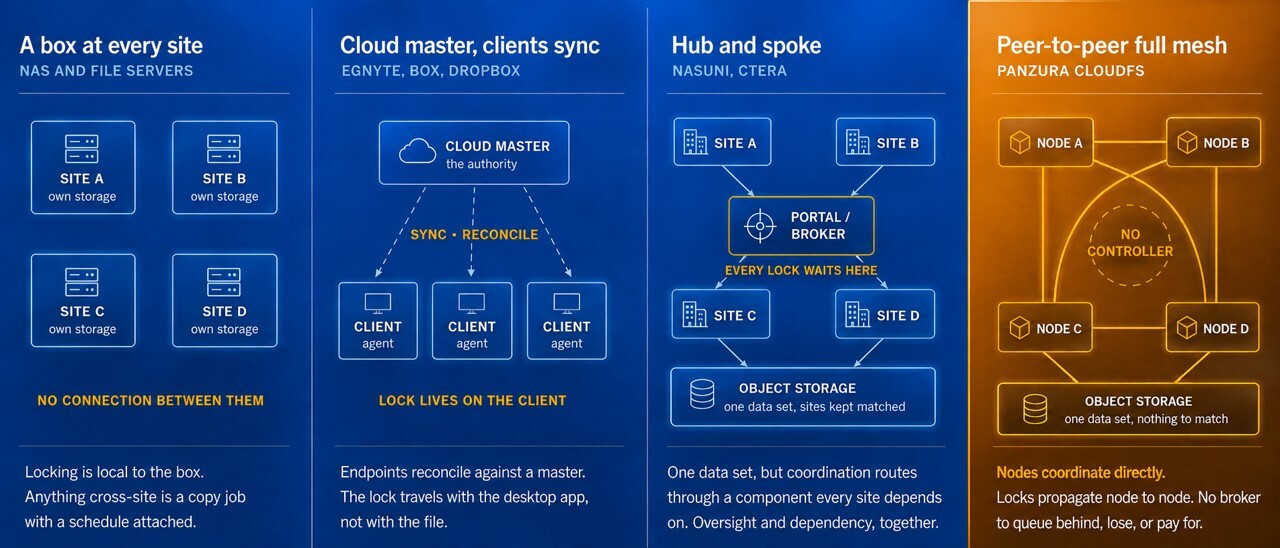
There are four ways to build a file estate. Only one has no controller in the middle.
Whatever you are running today and whatever else is on your shortlist, it uses one of these four models. The model decides what the platform can and cannot do, long before any feature list gets involved.
A mesh you can see all at once.
The most obvious benefit of a full-mesh peer-to-peer architecture comes first. Take away the central controller, a legacy approach to hub-and-spoke models, and the fair question is what replaces it as a place to look. CloudFS answers it without putting one back. Every node reports into a single operational picture, and one API call returns consolidated health across the entire ring — a single request your NOC dashboard, ITSM platform, or monitoring tool can poll.
-
Native Grafana Cloud integration through a secure connector that needs no inbound firewall ports
-
Executive overview and traffic-light health summaries with drill-down to any node
- One Health Check API call for ring-wide status, built for automated monitoring
-
Local HA pairs can be reconfigured without dropping user connections or repairing Active Directory
- A failover in progress can be canceled
What's right for you?
- CloudFS: One operational picture and one ring-wide health call, over an architecture where no site depends on the thing doing the watching. Visibility without a chokepoint.
- NAS / file share: One console per box. Estate-wide health is a person assembling it by hand, and it is out of date by the time it is assembled.
- Sync-and-share: Reporting covers the content platform. The on-premises caching layer is watched separately — two consoles, and neither shows the whole estate.
- Hub and spoke: The console is also the component every site's locking and policy coordination runs through — the oversight and the dependency come as a pair.
Why this matters:
With CloudFS, your team sees thirty sites in one view and acts on any of them without booking a window. Adding the thirty-first adds a node, not another console, another runbook, or another outage.
Distibuted file-locking engine
Legacy global file systems send every lock request to a central authority and wait. CloudFS nodes communicate directly in a full-mesh topology, so a lock taken in one office is visible in every other without a hub arbitrating.
- Peer-to-peer mesh coordination with sub-second propagation
- Byte-range locking for simultaneous editing inside one file
- No central authority to queue behind or lose
- Enforced consistently across SMB, NFS, and S3
- On by default, every deployment, no separate license
- A lock held by someone who went offline is released by your own team in minutes, without a support ticket
What's right for you?
- CloudFS: Node to node, always on, every file, every protocol, down to the byte range.
- NAS / file share: Locking is local to the box. Two sites, two locks, no relationship between them.
- Sync-and-share: Typically, achieves locking through a desktop app. The lock travels with the client, so it covers users on that client rather than every path to the data.
- Hub and spoke: Brokers locks in the cloud, or orchestrates them through a portal and only enabled on a complicated per-folder and -file type basis across each site.
Why this matters:
With CloudFS, your London and Dallas teams co-edit the same 50GB model in the same session. Real simultaneous collaboration, not near-time sync.
📄 Article | 9 min read
Intelligent edge caching
Distance causes WAN latency, not bandwidth. Every node holds the full global namespace in metadata so users browse millions of files instantly, while the working set caches locally and behaves like local storage.
- Metadata-first architecture for instant browsing at any node
- Caching with global deduplication keeps hot data local at a fraction of the footprint
- Write acceleration acknowledges locally, replicates behind the user
- Regional Store localizes data in regional buckets
- A site can be deactivated ahead of a storm or a power event and brought back when conditions improve, with ring status visible throughout
What's right for you?
- CloudFS: Full global namespace in metadata at every node, working set cached locally, writes acknowledged locally. Included, no separate license.
- NAS / file share: Local is fast, remote is slow. That is the entire story, and it is why branch offices end up with their own box.
- Sync-and-share: Cache mechanism brings caching on premises and requires a separate hybrid license. Offline operation may run up to seven days, and possibly only for folders served by Sync.
- Hub and spoke: What differs is what it has to compensate for, which is round-trip propagation time between sites before they match. Often with separate license.
Why this matters:
With CloudFS, distributed offices get local performance regardless of WAN bandwidth or distance. Nobody waits for a file to load. No separate license, no acquired sync layer.
📄 Article | 7 min read
Unified policy engine across every protocol
Geofencing and access control are enforced at the protocol layer rather than the storage layer, so a rule holds whether a user arrives over SMB, NFS, or S3. One authentication path removes the credential sprawl that separate object tiers create.
- File-level and folder-level geographic restriction at the node
- Native S3 alongside SMB and NFS on one data set, zero duplication
- Unified AD and Kerberos authentication across all protocols
- Real-time policy propagation with audit trails for GDPR, ITAR, and CMMC 2.0
What's right for you?
- CloudFS: One rule enforced at the protocol layer, identically over SMB, NFS, and native S3, under one AD and Kerberos identity.
- NAS / file share: Residency is typically solved by buying a box in each country. S3 access, if any, comes from a gateway bolted on the side.
- Sync-and-share: Permission and governance controls are applied to a content platform rather than to SMB, NFS, and S3 clients on one data set.
- Hub and spoke: Governance is offered through object protocol access that is served through a separate service rather than natively on the same data set.
Why this matters:
With CloudFS, you meet residency requirements without a second storage estate per region, and open S3 to AI pipelines while engineers keep working over SMB.
📄 Article | 7 min read
Multi-layer protection and recovery
Immutability is on before anyone configures anything. Every version is written as an encrypted WORM object with FIPS 140-3 certified encryption, and snapshots run as often as every 60 seconds with point-in-time recovery to any file or folder.
- Built-in immutable object storage, no enablement step
- Set-and-forget 60-second snapshots with granular point-in-time recovery
- AI-powered Threat Control builds behavioral baselines and flags mass encryption, mass deletion, and exfiltration
- Automated quarantine with granular restoration, so recovery is a folder rather than a rollback
- Hardened SMB: authentication is NTLMv2-only by default and SMB1 authentication has been removed
What's right for you?
- CloudFS: Immutable WORM from the first write, 60-second snapshots on by default, behavioral detection through Panzura Data Services.
- NAS / file share: The filer is the target and the backup is the second target. Protection is a separate product with its own window and its own licence.
- Sync-and-share: Version history and ransomware detection are typically paid add-ons, over a content store rather than immutable WORM objects.
- Hub and spoke: A recovery point quoted in minutes is a different conversation from one quoted in seconds, and the gap is whatever work happened in between.
Why this matters:
Attacks target backups, so protection has to be inherent. With CloudFS, immutability prevents destruction and detection stops propagation.
📄 Article | 6 min read
Live matters more once agents are the ones reading.
A person who opens last Tuesday's revision usually notices. An agent does not — it acts on what it retrieves, and hands the result to the next step in a chain that also acts. Everything on this page gets more valuable the moment automation is the consumer, because there is no judgment in the loop to catch what the data layer got wrong.

Agentic workflows put output back into the estate — generated documents, revised schedules, updated records — alongside dozens of people in a dozen offices. The moment automation becomes a writer, concurrency control stops being a collaboration feature and becomes a data integrity requirement.
- Locking is enforced at the protocol layer, so the lock governing an engineer in Singapore governs a process running in Azure — it sits below both
- Byte-range locking lets automation and people work different regions of the same file without either overwriting the other
- One authoritative data set means an agent cannot act on a revision that has not caught up yet
- Every write lands as an immutable version, so anything automation does can be rolled back to the second

An agent covers more of a file estate in a minute than a person covers in a week. Freshness on the read side is the easy half — the harder question is the other direction: when someone loses access to a folder, how long before the AI stops answering from it? Every hour of that gap is exposure that scales with reach.
- Panzura Nexus ingests on file events rather than on a schedule, so a save reaches Copilot in seconds
- Permissions are evaluated at query time, so a revocation takes effect on the next request rather than the next crawl
- NTFS permissions map to Entra ID claims — if someone cannot open a file in Explorer, they cannot reach it through an agent
- Generally available and running in production today, unlike competitive handwaving that promises a future release

Telling an agent to respect a jurisdiction or a client wall is guidance, and guidance is not enforcement. Autonomous workflows need geographic and access limits applied by the data layer itself — and a record of what the agent actually reached, on every path it can take.
- Native S3 alongside SMB and NFS on one data set, so pipelines reach the same files your teams open with no staging copy and no ETL
- Geofencing enforced at the protocol, identically over all three, so a rule holds regardless of how the agent arrives
- GDPR, ITAR, and CMMC 2.0 boundaries met without standing up separate storage per jurisdiction
- Audit events stream to your SIEM and compliance platform from one feed, so agent activity is observable in the tools you already run

Panzura Nexus
Your CloudFS files answerable in Microsoft 365 Copilot.
Your teams already have Microsoft 3265 Copilot. It cannot see the drawings, specifications, contracts, and proposals in your files, which is most of what your firm actually knows. Panzura Nexus closes that gap without moving a file.
If someone cannot open or see a file in CloudFS they cannot discover it through Copilot. Revoke access or change permissions and the effect propagates in seconds, because ingestion is event-driven rather than a nightly crawl.
This is the line most Copilot integrations cannot hold and it is the line that decides whether you can let an agent loose on the estate at all.
Panzura Data Services
One view across the entire unstructured data estate. Essentials ships with every CloudFS deployment for baseline monitoring. Standard adds the search, forensics, and audit depth that turns a compliance request into a query.
-
Global search and one-click recovery in seconds
-
Monitor system health, activity, and connectivity
-
Audit-ready reports with near-real-time tracking
-
Analyze consumption and surface recommendations
- Audit events stream in real time to several third-party platforms at once, so a SIEM, a compliance tool, and a monitoring tool each take the same feed
Panzura Edge
Extend the global file system to every user, machine, and process regardless of location, without a VPN. Built for remote offices, field sites, temporary project teams, and edge deployments.
- High-performance local caching anywhere
- LAN-speed file access for remote locations
- VPN-less, real-time collaboration consistency
- Support for transient and mobile teams
How CloudFS wins every time
Winning capabilities head-to-head against the competition.
Many organizations arriving here are not switching cloud file platforms. They are leaving a NAS estate or a sync product, and the shortlist gets built later. These are the differences that decide whether consolidation eliminates version conflicts and ransomware exposure, or simply relocates them.
📄 White Paper | Choosing the Right File Data Solution for AEC: Panzura CloudFS vs. The Competition
|
Capability
|
NAS / File Server
|
Sync-and-Share
|
Hub and Spoke
|
Panzura CloudFS
|
|---|---|---|---|---|
|
One authoritative data set
|
No — one estate per location
|
Cloud master, endpoints reconcile against it
|
One data set, with propagation between sites to keep them matched
|
One data set, and nothing propagating between sites
|
|
Real-time global file locking
|
Local to the box only
|
Client-mediated, through the desktop app
|
Brokered through a cloud service or portal
|
Node to node, no broker, always on
|
|
How locking is enforced
|
By the file server
|
By the desktop client
|
By a cloud broker or client
|
At the protocol, for any SMB, NFS, or S3 client
|
|
Byte-range locking
|
No
|
Not published
|
Not published
|
Yes — simultaneous editing inside one file
|
|
Collaboration and acceleration licensing
|
Not available at any tier
|
On-premises caching requires the hybrid license tier
|
Sold as an add-on service, or included but scoped by policy, depending on vendor
|
Included in every deployment, unscoped, nothing to enable
|
|
Ransomware-proof immutability
|
No — the backup is the second target
|
Version history; detection commonly an add-on
|
Immutable snapshots, cadence varies by platform
|
WORM from the first write, on before configuration
|
|
Recovery point
|
Hours to days
|
Version history, platform-defined
|
Minutes
|
Seconds — snapshots as often as every 60
|
|
Behavior during an outage
|
Local box keeps serving; no cross-site reconciliation
|
Up to 7 days offline, Sync-served folders only
|
Cached data remains available
|
Full read and write, automatic reconciliation on return
|
|
Global performance
|
Poor — WAN latency
|
Smart Cache on premises, separate hybrid license
|
Smart Cache on premises, separate hybrid license
|
Metadata-first cache with nothing to propagate behind it
|
|
Capacity scaling
|
Expensive refresh cycles
|
Cloud scale, tiered allocations
|
Object scale; per-site overhead grows with the estate
|
Object scale, and cost per site falls as sites are added
|
|
Storage reduction
|
Requires separate dedupe
|
Cloud-side efficiency
|
Deduplication and compression
|
Up to 80% less stored capacity, deduplicated across every site
|
|
Native S3 on the same data set
|
Gateway add-on
|
API access to the content platform
|
Object access via a separate service
|
Yes — native protocol, no gateway, same permissions
|
|
Data residency enforcement
|
Buy storage in each country
|
Platform-level controls
|
Portal-administered; a separate service governs the S3 path
|
File-level, enforced at the protocol, identical over SMB, NFS, and S3
|
|
What the license includes
|
Capital purchase per box
|
Primarily per user
|
Capacity-based, with capabilities tiered above it
|
Capacity-based, with locking, immutability, snapshots, and geofencing in the base
|
← Swipe to see more →
Customer Case Studies
Real customer results: Distributed teams that stopped managing file infrastructure.
Global AEC firms, manufacturing companies, and healthcare organizations have eliminated file collisions, benefited from the industry's fastest Recovery Point Objective, and cut storage costs by up to 80% after migrating from legacy NAS and cloud file solutions to CloudFS. Read how distributed teams solved their most difficult file data management challenges.
AFRY Achieves Azure Optimization & Savings, Zero Downtime Infrastructure
AFRY unifies 18,000 engineers across 100 offices with CloudFS. They have achieved real-time global collaboration on Revit files, major storage savings, near-zero migration downtime.
High Performance Data Access, Collaboration & Resilience Propels Stoke Space into Orbit
Stoke Space Technologies achieves 5-minute test data turnaround across vast distances with CloudFS. Engineers iterate faster, accelerating their path to fully reusable rockets.
New Orleans Saints Slash Costs, Drive Data Resilience & Recovery with Cloud Move
The New Orleans Saints organization migrated terabytes to Google Cloud with CloudFS, breaking endless storage refresh cycles, slashing cloud costs, and saving energy outlays.
Timmons Group Eradicates Data Silos, Consolidates File Data Across Branch Offices
Timmons Group eliminated data silos across 16 offices with Panzura CloudFS. File load times dropped from 5-6 minutes to mere seconds, enabling seamless cross-office collaboration.
Skyscanner Books CloudFS for Its Journey to Secure, Reliable File Data Management
Skyscanner eliminated file-sharing issues while enabling new cross-office collaborations with CloudFS. Teams around the world now work faster and smarter with 24/7 access.
U.S. Defense Contractor Cuts Costs, Boosts Collaboration, Security with CloudFS
DoD (now DoW) contractor moved to Azure Gov Cloud with CloudFS, meeting NIST 800-171 requirements. Teams now collaborate on SolidWorks files in real time across sites.
Pret Simplifies Worldwide File Data Management, Improves User Experience
Pret A Manger enables global teams to collaborate on large Adobe files across London, New York, and Hong Kong with CloudFS for faster time-to-market and significant cost savings.
TLC Delivers 200+ Additional Billable Hours Per Designer, Per Year
TLC Engineering saves 4-5 hours per designer weekly with Panzura CloudFS. Revit models now open in seconds instead of 25+ minutes, enabling real-time collaboration across 16 sites.
This analysis is based on publicly available information, vendor documentation, industry research, and independent technical evaluations. Organizations should conduct their own assessments based on specific requirements and environments. *All product and company names are trademarks or registered® trademarks of their respective holders. Use of those names does not imply any affiliation with or endorsement by their owners. The opinions expressed above are solely those of Panzura LLC as of August 2026, and Panzura LLC makes no commitment to update these opinions after such date.
Take your next step.
Talk to a Panzura expert. We'll evaluate your specific environment, show you the business outcomes you can expect, provide guidance, and help you plan your deployment.